How to Choose the Right HTD 14M Pulley?
Choosing the right Htd 14m Pulley starts with more than matching a belt’s pitch. The 14 mm tooth spacing is only one part of the fit. Engineers also need to check tooth profile, pulley width, tooth count, shaft bore, and operating load. A mismatch can cause uneven tooth contact, vibration, or premature belt wear. Small details matter.
Industry references help turn those details into a practical selection. ISO 13050:2014 describes metric curvilinear synchronous belt drives, while Gates’ PowerGrip GT3 Drive Design Manual provides guidance on drive sizing and design factors. Use these resources alongside the belt and pulley manufacturer’s current product data. They can help verify speed, transmitted torque, tooth engagement, and center distance. Do not assume that two pulleys with the same pitch are interchangeable; profile and dimensional details still need checking.
Before ordering, compare the pulley drawing with the actual assembly. Measure the shaft, confirm the required bore and keyway, and check whether the pulley can fit beside nearby guards or brackets. Then review the load pattern. Frequent starts, shock loads, and long operating hours may change the selection. There is no universal “best” pulley. Even a careful calculation can miss an installation constraint, so a physical fit check is worth the extra time. A clear specification prevents avoidable rework.
Identify the HTD 14M Profile: 14 mm Pitch and Tooth Compatibility
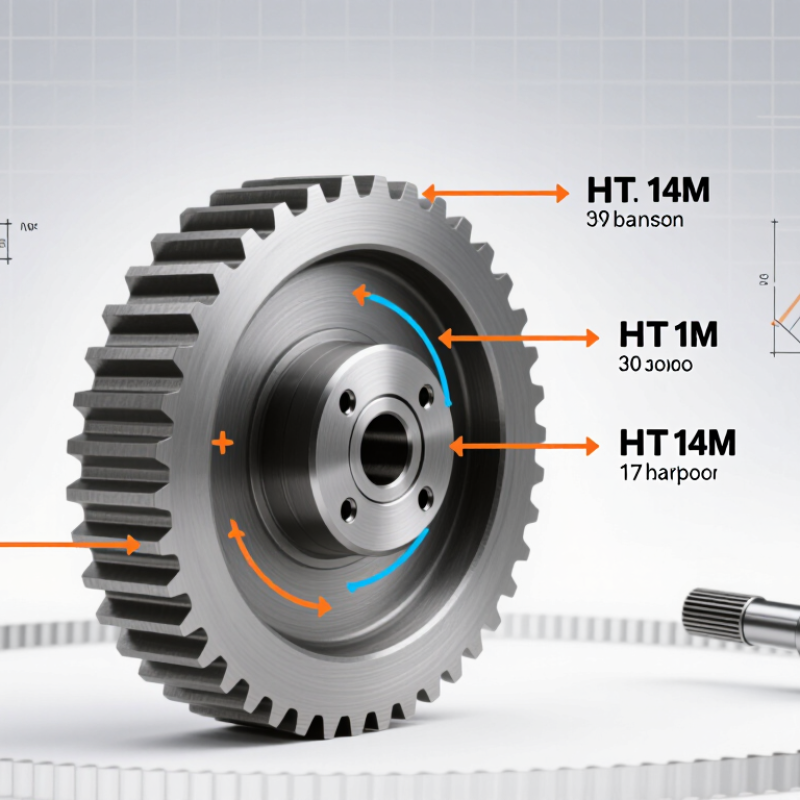
An HTD 14M pulley uses a 14 mm pitch: the spacing between matching points on neighboring belt teeth. Do not confuse pitch with belt width or pulley diameter. Those measurements describe different features. HTD also refers to a curved tooth profile, so the belt and pulley must share compatible tooth geometry. A belt that appears close may still ride poorly if its tooth shape differs.
Check the belt marking, then confirm the profile in the equipment documentation. If markings are missing, compare the belt’s tooth spacing and shape with a verified sample. A caliper can help check dimensions, but measuring across one tooth alone can be misleading. Look at several tooth intervals. Small measurement errors add up. A common selection mistake is matching only the 14 mm pitch while overlooking profile compatibility. Also confirm belt width, pulley tooth count, shaft fit, and flange arrangement for the application. The label alone can mislead. Inspect wear, too; rounded or damaged teeth make a sound match harder to judge. When uncertainty remains, compare parts directly before installation, and check that the belt seats without forcing it.
How to Choose the Right HTD 14M Pulley? - Identify the HTD 14M Profile: 14 mm Pitch and Tooth Compatibility
| Selection factor |
Specification or example |
What to check |
| Profile designation |
HTD 14M |
Match the pulley profile to a belt specified for the same 14M tooth profile. |
| Tooth pitch |
14 mm between corresponding points on adjacent teeth |
Confirm the belt pitch is also 14 mm. Matching pitch alone does not ensure tooth-profile compatibility. |
| Tooth compatibility |
14M belt teeth must seat correctly in 14M pulley grooves |
Do not substitute a pulley with a different tooth profile, even if its pitch appears similar. |
| Pitch diameter calculation |
Pitch diameter ≈ (14 mm × tooth count) ÷ π |
Use this estimate to compare pulley sizes; it is the pitch diameter, not the outside diameter. |
| Tooth count: 20 |
Pitch circumference: 280 mm; pitch diameter: approximately 89.13 mm |
A smaller tooth count gives a smaller pitch diameter. |
| Tooth count: 24 |
Pitch circumference: 336 mm; pitch diameter: approximately 106.95 mm |
Check that the selected tooth count meets the required speed ratio and space constraints. |
| Tooth count: 30 |
Pitch circumference: 420 mm; pitch diameter: approximately 133.69 mm |
For a two-pulley drive, the tooth-count ratio determines the nominal speed ratio. |
| Tooth count: 36 |
Pitch circumference: 504 mm; pitch diameter: approximately 160.43 mm |
Verify the pulley fits the available center distance and installation envelope. |
| Tooth count: 40 |
Pitch circumference: 560 mm; pitch diameter: approximately 178.25 mm |
Confirm the chosen tooth count is suitable for the required drive layout and belt length. |
| Belt and pulley width |
Select a pulley face width suitable for the belt width and application |
Check the manufacturer’s dimensional drawing for usable face width, flanges, and any required clearance. |
Pitch diameter values are calculated from the nominal 14 mm pitch and are rounded to two decimal places.
Choose Tooth Count and Pitch Diameter: Dp = 14z/π mm
For an HTD 14M pulley, tooth count gives a quick estimate of pitch diameter. Use Dp = 14z/π mm, where z is the number of teeth. A 30-tooth pulley has a pitch diameter of about 133.7 mm. This is the diameter measured along the belt’s pitch line, not the pulley’s outside edge. That difference matters when checking shaft spacing or available clearance.
Tips: Count the teeth carefully, then calculate the diameter before ordering or machining. Check the result against your layout drawing. Leave room for the belt and nearby parts.
Tooth count also affects the drive ratio. With a fixed driver, a larger driven pulley turns more slowly, while a smaller one turns faster. Compare both pulley counts before settling on a design. The formula is neat; real installations are less so. Belt tension, alignment, and mounting space can shift what works in practice. Confirm the specified tooth profile and dimensions, and check clearances on the actual assembly. A calculated diameter is a useful start, not the whole fit.
How to Choose the Right HTD 14M Pulley?
Choose the tooth count to suit your drive ratio and space requirements. The theoretical pitch diameter is calculated as Dp = 14z / π mm, where z is the number of teeth.
Example: A 28-tooth pulley has a theoretical pitch diameter of about 124.8 mm. Pitch diameter is not the same as the pulley’s outside diameter.
Match Belt Width and Pulley Face to the Drive’s Load Requirements
Selecting an HTD 14M pulley starts with the belt, not the pulley catalog. Confirm the belt’s pitch, width, tooth profile, and rated capacity. A wider belt can carry more load, but only when the belt, pulley, shafts, and bearings are designed for it. Check torque, speed, starts per hour, and shock loads. A conveyor that starts with a full load needs a different margin than a lightly loaded fan. Details matter.
The pulley face must support the belt teeth across its working width. Choose a face width that matches the belt supplier’s requirements, allowing for proper tracking and manufacturing tolerances. Too narrow, and the belt may overhang or wear at its edges. Much wider is not automatically safer; poor alignment can still push the belt sideways. That happens.
Also verify the pulley’s tooth count and pitch diameter against the required ratio and shaft speed. For example, a compact pulley may fit the frame but increase belt bending and tooth loading. Check the duty cycle and available wrap angle before settling on a width. I would not size from motor power alone; real starts, jams, and alignment errors change the load. Review the drive layout, then confirm dimensions and ratings with the belt and pulley specifications.
Select Bore, Hub, and Material for Shaft Torque and Operating Speed
For an HTD 14M pulley, start with the shaft, not the catalogue photo.
The 14 mm tooth pitch identifies the belt system; ISO 5294:2012 provides dimensional requirements for synchronous-belt pulleys. Measure the shaft diameter, then specify a matching bore and suitable keyway or clamping arrangement. A loose fit can fret under reversing loads. An oversized bore can leave too little hub wall around the keyway. Small details matter.
Calculate nominal torque with T = 9550 × power (kW) ÷ speed (rpm).
For a 5.5 kW drive at 600 rpm, that is about 87.5 N·m. Add the machine’s service factor and startup loads before selecting the hub.
Material choice depends on both torque and speed.
Steel generally suits high loads and frequent shock; aluminum reduces rotating mass but needs adequate hub strength. Check the pulley maker’s rated torque and maximum speed for the exact bore, hub, and material combination. Also consider shaft alignment, key dimensions, and whether the pulley will overhang its support. A lighter pulley is not automatically a better one. The torque calculation is only a starting point; it can miss peak loads during acceleration. Confirm the operating duty and inspect the fit after installation.
Check Alignment, Flanges, and Manufacturer Tolerances Before Installation
How to Choose the Right HTD 14M Pulley?
An HTD 14M pulley has a nominal tooth pitch of 14 mm, but pitch alone does not confirm compatibility. ISO 13050:2014 covers metric-pitch curvilinear synchronous belt systems; check the pulley drawing and belt specification for the matching tooth profile and dimensions. Before installation, place a straightedge across the pulley faces or use a dial indicator to check alignment. Also verify that the shafts are parallel and the pulley faces sit square. Small errors matter. A pulley can look centered while its flanges still rub the belt edge.
Tips: Inspect flange spacing, burrs, and tooth damage under good light. Compare bore, keyway, and face width with the drawing. Ask the manufacturer for allowable axial and angular misalignment; tolerances vary by design. Don’t assume a “standard” limit applies.
Record the measured values before tightening the assembly. Rotate the drive by hand and watch whether the belt tracks centrally, without climbing a flange. If tracking shifts, stop and recheck alignment, shaft runout, and mounting faces rather than adding tension. Excess tension may hide a setup problem, and it can increase bearing loads. A slightly awkward detail: readings can change after tightening, so measure again with fasteners secured. Keep the manufacturer’s tolerance sheet with the maintenance record.



 +86-19862000127
 Phone
Phone Email
Email