Inquiry
Form loading...

2026 Best Conveyor Brush Types for Global Buyers

Choosing the right Conveyor Brush in 2026 requires more than comparing bristle density or catalog prices. Global buyers face different dust loads, belt widths, temperatures, and cleaning standards. A brush suitable for dry grain may fail beside oily packaging lines. Nylon, polypropylene, stainless steel, and antistatic filaments each solve different problems.

Industry data shows why this decision matters. MarketsandMarkets projects the global conveyor systems market to grow from approximately USD 10.6 billion in 2023 to USD 14.5 billion by 2028. Grand View Research also reports continuing growth in industrial brush demand through the decade. These reports measure broader markets, not Conveyor Brush sales alone. Their definitions differ, so the figures should guide planning rather than dictate purchases.

R. Todd Swinderman, a respected conveyor-performance specialist and former Martin Engineering president, often emphasizes a practical principle: “The best conveyor is safe, reliable, and easy to maintain.” That principle fits brush selection closely. A durable brush should remove carryback without damaging belt surfaces or trapping product around the shaft. It should also permit quick replacement, especially where downtime costs more than the brush itself.

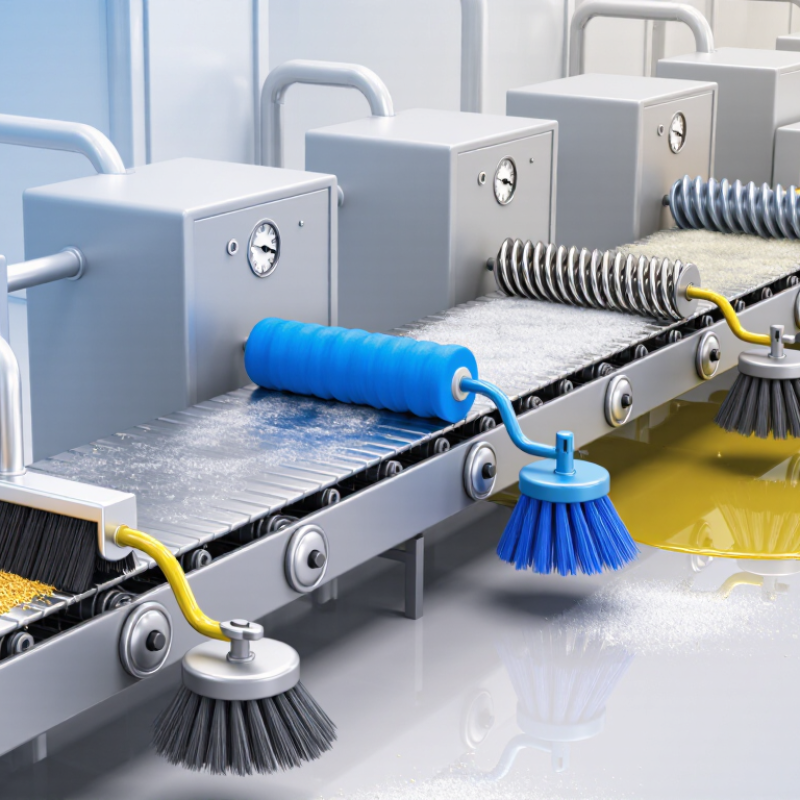
This guide compares strip brushes, roller brushes, spiral brushes, and specialty antistatic designs for global buyers. It considers cleaning force, wear life, moisture exposure, installation, and total operating cost. The ranking is not absolute. Real factories are messier than laboratory tests. Sometimes, a cheaper polypropylene brush performs better than premium nylon, but only under the right conditions. Expect useful direction, not a perfect answer.
2026 Best Conveyor Brush Types for Global Buyers

Classify Conveyor Brushes by Belt Width, Speeds of 0.5–5 m/s, and Load

For global buyers, conveyor brushes should be classified by belt width, operating speed, and load rather than appearance alone. For belts under 500 mm, compact strip or spiral brushes usually suit light cleaning duties. Between 500 and 1,000 mm, wider roller brushes offer better coverage and stable contact. Belts above 1,000 mm often need segmented rollers, stronger shafts, and adjustable supports. CEMA’s Belt Conveyors for Bulk Materials, 7th Edition, links conveyor capacity with belt width, speed, material density, and loading conditions.

Speed changes the brush design quickly. At 0.5–1 m/s, softer bristles can remove dust without excessive belt wear. From 1–3 m/s, medium-stiff bristles and balanced rollers are safer choices. At 3–5 m/s, dynamic balance, bearing protection, and controlled contact pressure become critical. ISO 5048 recommends checking belt tensions and power requirements under actual loading, not empty-belt conditions. That detail is often missed.

Load should be measured as mass per metre, not described only as “heavy.” As a practical screening guide, under 25 kg/m is light, 25–75 kg/m is medium, and above 75 kg/m requires engineering verification. MHI’s 2024 Annual Industry Report identifies throughput and labor pressure as major automation concerns, but higher speed is not always the answer. I have seen oversized brushes create heat, noise, and premature bristle loss. A small trial section may reveal more than a confident spreadsheet.
Compare Roller, Strip, Spiral, and Disc Brushes for Four Cleaning Tasks

2026 Best Conveyor Brush Types for Global Buyers

Choosing a conveyor brush depends on the cleaning task, product shape, and line speed. No brush wins every trial. I have found that small changes in bristle stiffness can affect results more than expected.

Roller brushes suit broad, flat surfaces. They remove dust, loose soil, and light residue while products pass continuously beneath them. Strip brushes work better for edge cleaning, sealing gaps, or guiding small parts. Their simple structure also makes replacement practical. However, poorly supported strips may bend and leave narrow dirty lines.

Spiral brushes create a stronger sweeping action along the conveyor path. They are useful for clearing packed debris from irregular products or long surfaces. Disc brushes provide targeted contact around corners, grooves, and individual items. They often perform well when cleaning zones need separate adjustment. Still, disc spacing requires careful testing. Too much pressure can mark soft packaging or slow product movement.

Global buyers should compare brush diameter, filament material, mounting method, wash temperature, and expected service life. A food-contact application may require documented material suitability and controlled cleaning procedures. Industrial dust may need a different filament profile. Test the brush with real product samples, not only specifications. Measure residue after several cycles. The first trial can look convincing, but wear may change the result.

Match Nylon, PP, Steel, and Mixed Fills to Heat and Abrasion Data

2026 Best Conveyor Brush Types for Global Buyers

Global buyers should match brush fill to measured heat and abrasion data, not catalog habit. Nylon suits demanding cleaning duties where wear resistance matters, but moisture can change its stiffness and dimensions. Polypropylene performs well on wet or chemically exposed lines, yet sustained heat can soften it. At a 90°C surface reading, PP deserves scrutiny. Steel survives severe abrasion and higher temperatures, but it may scratch delicate surfaces and increase belt wear. Mixed fills balance cleaning force, flexibility, and service life. The compromise is real.

CEMA’s Belt Conveyors for Bulk Materials, 7th Edition, emphasizes application-specific loading, speed, and material conditions. For screening, compare fills under ASTM G65 Procedure A, using a 1,000-gram load and 6,000 wheel revolutions. Record temperature continuously, because dwell time and thermal cycling often matter more than peak temperature. Do not trust one laboratory score. I have seen dry tests mislead buyers when sticky fines packed the brush face. That detail is easy to miss. Field trials should log belt speed, product moisture, fill deflection, and replacement intervals. ASTM G65 abrasion results need practical verification beside the conveyor. Supplier data sheets help, but actual operating records remain more reliable.

Specify 10–20% Bristle Compression for Consistent Brush-to-Belt Contact

2026 Best Conveyor Brush Types for Global Buyers

Specify 10–20% Bristle Compression for Consistent Brush-to-Belt Contact

Conveyor brushes perform best when bristles maintain steady contact without excessive drag. Specify 10–20% compression from the free bristle height. For a 50 mm bristle, this means 5–10 mm of controlled deflection. Light contact can leave dust, labels, or small parts behind. Excessive pressure can raise motor load and accelerate bristle fatigue. Pressure matters. Grand View Research forecasts continued growth in the global conveyor system market through 2030, increasing demand for reliable cleaning and product-handling components. That growth does not make every brush specification correct.

Choose strip brushes for side sealing and narrow transfer points. Use roller brushes when continuous surface cleaning requires adjustable speed and coverage. Spiral brushes suit wider belts, but pitch and rotation direction need careful testing. Measure compression at operating temperature, not only during assembly. Belt vibration, moisture, and uneven loading can change contact noticeably. A simple test should record current draw, belt marks, and cleaning results after several hours. The 10–20% range is practical, not sacred. Some soft bristles need more deflection, while abrasive products may require less. Buyers should request bristle material, trim length, shaft tolerance, and compression data before approval. ISO 9001-based supplier controls can improve traceability, but they cannot replace an on-site trial.

2026 Best Conveyor Brush Types for Global Buyers - Specify 10–20% Bristle Compression for Consistent Brush-to-Belt Contact

Brush Type Typical Conveyor Function Recommended Bristle Material Recommended Bristle Compression Typical Bristle Diameter Suitable Belt or Product Conditions Key Selection Advantage
Strip Brush Sealing gaps, guiding products, removing loose debris, and controlling material flow along conveyor edges. Polypropylene, nylon, or stainless steel wire for higher-temperature and abrasive service. 10–15% 0.20–0.50 mm for synthetic filaments; 0.15–0.30 mm for fine wire. Side guides, transfer points, dust containment, and light-to-medium contact. Easy to cut, replace, and configure in straight or curved mounting channels.
Roller Brush Cleaning, scrubbing, dust removal, surface treatment, and controlled product movement. Nylon for durability, polypropylene for moisture resistance, or abrasive nylon for stronger cleaning action. 10–20% 0.20–0.80 mm, selected according to cleaning intensity and product sensitivity. Flat belts, modular belts, rollers, and continuous high-throughput lines. Provides continuous contact over a defined working width and can be driven or belt-powered.
Spiral Roller Brush Cleaning wide belts while transporting removed particles toward a discharge side. Nylon, polypropylene, or mixed filament designs for combined cleaning and conveying. 10–15% 0.25–0.60 mm for general industrial cleaning. Wide conveyors, food handling lines, packaging systems, and applications requiring lateral debris movement. Helical filament arrangement helps reduce buildup in one location and supports directional cleaning.
Disc Brush Cleaning irregular surfaces, removing residue from rollers, and handling localized contact zones. Nylon, polypropylene, polyester, or abrasive nylon depending on surface finish requirements. 10–20% 0.20–0.80 mm synthetic filament diameter. Intermittent cleaning, sprockets, narrow contact areas, and products with uneven geometry. Individual discs can be combined to create flexible brush widths and cleaning patterns.
Antistatic Brush Discharging or reducing static electricity on conveyed films, sheets, labels, and electronic components. Conductive carbon fiber, stainless steel fiber, or conductive synthetic filament. 10–15% Approximately 7–20 μm for fine conductive fibers; larger filaments may be used for mechanical contact. Dry environments, film handling, printing lines, packaging equipment, and sensitive electronic products. Supports controlled static dissipation when correctly grounded and installed.
Food-Contact Brush Cleaning, guiding, separating, or transferring food products on hygienic conveyor systems. Food-contact-grade polypropylene, polyester, or nylon selected according to local compliance requirements. 10–15% 0.20–0.50 mm for general food handling; softer filaments for delicate products. Wet or dry food processing, washdown areas, packaging lines, and product handling. Can be specified with detectable materials, hygienic blocks, and corrosion-resistant supports.
High-Temperature Brush Handling or cleaning materials exposed to elevated process temperatures. Stainless steel wire, heat-resistant aramid, or other temperature-rated specialty fibers. 10–15% 0.15–0.50 mm, depending on heat, abrasion, and required surface pressure. Metal processing, glass handling, thermal processing, and hot-part conveying. Maintains functional contact where standard polypropylene or nylon filaments may soften or degrade.
Abrasive Brush Deburring, light finishing, oxide removal, surface preparation, and controlled material abrasion. Nylon filaments impregnated with silicon carbide or aluminum oxide abrasive particles. 10–15% 0.30–1.00 mm, commonly selected with abrasive grit according to finish requirements. Metal, wood, composite, and engineered-material processing where controlled abrasion is required. Produces repeatable brushing action while reducing the need for rigid cutting tools.
Soft Product-Handling Brush Supporting, cushioning, orienting, or gently transferring fragile products without sharp impact. Soft polyester, fine nylon, polypropylene, or elastomeric filaments. 10–12% 0.10–0.30 mm for delicate products and low-contact-pressure applications. Glass, polished parts, fresh produce, cartons, lightweight packages, and coated surfaces. Minimizes marking and product deformation when filament stiffness and compression are correctly matched.
Heavy-Duty Cleaning Brush Removing compacted dirt, scale, residue, and coarse particles from robust conveyor surfaces. Stiff nylon, polypropylene, polyester, or crimped stainless steel wire. 15–20% 0.40–1.20 mm, subject to belt hardness, contamination level, and cleaning speed. Aggregate, recycling, agricultural, mining, and industrial material-handling conveyors. Higher filament loading and compression increase cleaning force for durable surfaces.

Engineering note: The 10–20% compression range is a practical starting specification for maintaining continuous brush-to-belt contact. Final compression should be verified against belt hardness, brush speed, filament stiffness, product sensitivity, contamination load, temperature, and allowable drive torque.

Check FDA 21 CFR 177.2600 and EU 1935/2004 Food-Contact Compliance

2026 Best Conveyor Brush Types for Global Buyers

Food-contact compliance should guide conveyor brush selection, not appear after installation. Nylon or polypropylene bristles may suit dry foods, while flexible elastomers help with sealing and gentle product handling. However, every component matters, including the backing, adhesive, coating, and lubricant.

FDA 21 CFR 177.2600 mainly addresses repeated-use rubber articles. It may apply to elastomeric brush parts, but not automatically to every brush assembly. Request declarations, formulation details, and migration or extraction test results. Check the tested temperature, food type, contact time, and cleaning conditions. A general “food-safe” statement is not enough.

For European supply chains, Regulation (EC) No 1935/2004 requires materials to avoid harmful migration and unacceptable changes in food taste or odor. Traceability and supporting documentation are also important. Good manufacturing practice under Regulation (EC) No 2023/2006 may support the assessment. A certificate alone can mislead. I would not approve a brush from its material name alone. Inspect bristle shedding, trapped residue, welds, and cleanability under real conveyor conditions. Documentation can still be incomplete, especially when suppliers combine parts from different sources. That gap deserves attention.

2026 Best Conveyor Brush Types for Global Buyers

Representative maximum continuous-use temperature by brush filament or contact material

Nylon 6.6 and PBT are common choices for general food-handling conveyor applications, polypropylene is suitable for lower-temperature and chemical-resistant duties, and stainless steel is preferred where high temperature or heavy scrubbing is required. FDA 21 CFR 177.2600 applies specifically to certain rubber articles intended for repeated food contact; it does not automatically approve every brush filament. EU Regulation 1935/2004 requires food-contact materials to be safe and traceable, so buyers should request material-specific declarations, migration information, and processing details before approval.

Temperature figures are representative engineering ranges and may vary by grade, load, moisture, cleaning chemicals, and brush construction. Final compliance must be verified for the complete finished brush.